Learning from eco groups
Co-designing a university environmental course with students and staff, using places like Earthsong to rethink how a learning space is built.
- Role
- Founder, co-researcher
- Partners
- School of Environment students and staff
- Methods
- Field visits, pop-ups, focus groups, walking workshops
Question
Most courses are designed by staff and delivered to students. We set out to build the first course at the university co-designed by students and staff together: a Stage III special topic in the School of Environment. I was curious, how do built environments shape the way people learn, and who gets to take part? Where people sit, who talks to whom and who stays quiet are all design decisions.
Field visits
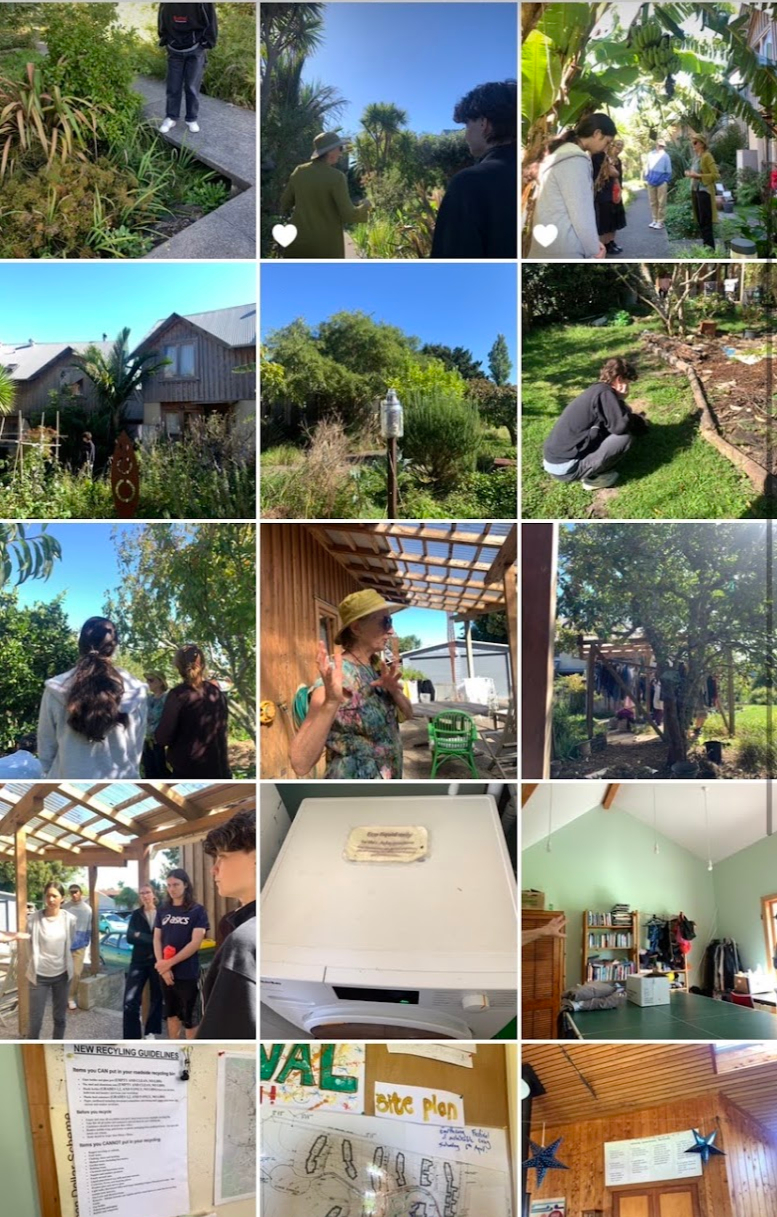
Instead of starting only from literature, we studied places already organized around shared decisions: ecovillages, cohousing communities and schools. Earthsong, a cohousing neighborhood in Auckland, was a central visit. Communities like it are built to make cooperation the easy default, with homes facing shared paths and a common house for meals and meetings. We asked what a classroom would look like if it borrowed the same logic.
Experimental tools
Pop-up tables. A table on campus with one question, would you change how the university runs? A sticker board let anyone signal interest in seconds, and those who cared most were invited to focus groups.
Walking workshops. Nature walks replaced meetings as a way in. The first one drew around 20 people, from first-year undergraduates to PhD students, who would rarely share a room otherwise.
Paper mapping. Each session started with "co" and "design" on paper. We circled the words that kept coming up and turned them into a shared diagram of the questions to pursue.
A shared memory. Short summaries after every decision and one shared folder, so what the team learned would outlast any one person on it.
What the spaces taught us
Participation follows design. Low-effort ways in, like a sticker or a walk, reached people a formal meeting never would, and deeper involvement grew from there. Moving outdoors flattened the usual hierarchy between staff and students. We also recruited on purpose for perspectives a course team often lacks, including Māori and Indigenous, mature and lower-income students.
The work fed into the co-design of an established environmental course and improvements to how students and educators shape curriculum together.